Aid & Development · Explainer
Clean Water Projects
Drilling a borehole is the easy part; safe water depends on service levels, spare parts, local management and hygiene alongside the tap.
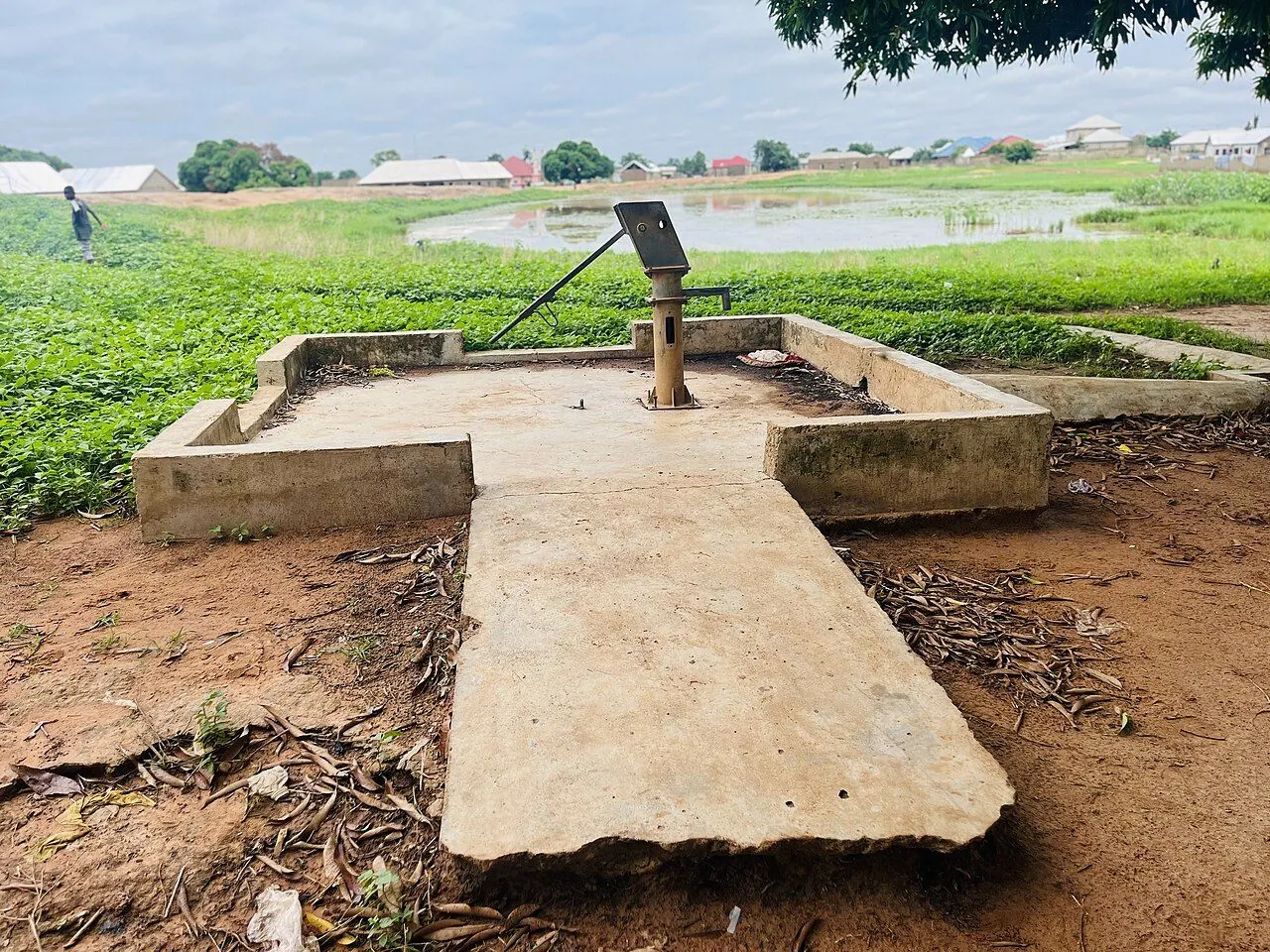
Photo: Knowledge and philosophy / Wikimedia Commons, CC BY-SA 4.0
A clean water project is more than a water source: it is a reliable service, and constructing water facilities is only the start. Global standards judge water by whether it is close at hand, available when needed and free from contamination, and that depends on maintenance and local management long after the drilling rig has gone.
What safe water means
The WHO/UNICEF Joint Monitoring Programme (JMP), the custodian of global data on water, sanitation and hygiene, sorts drinking water into a service ladder. An "improved" source is one that, by its design and construction, can deliver safe water: piped water, boreholes or tubewells, protected dug wells, protected springs, rainwater, and packaged or delivered water.
| JMP service level | Definition |
|---|---|
| Safely managed | An improved source that is accessible on premises, available when needed and free from faecal and priority chemical contamination |
| Basic | An improved source, with collection taking no more than 30 minutes for a round trip including queuing |
| Limited | An improved source, but collection takes more than 30 minutes for a round trip |
| Unimproved | An unprotected dug well or unprotected spring |
| Surface water | Water taken directly from a river, dam, lake, pond, stream or canal |
Wells, boreholes and piped supplies
A borehole or tubewell is a deep hole driven, bored or drilled to reach groundwater, with casing or pipes to stop it collapsing and to keep contaminated run-off out. Water is lifted by a pump that may be powered by hand, animal, wind, electricity, diesel or the sun; in many villages it is a hand pump. A protected dug well is lined or cased above ground level, with a headwall and an apron that diverts spilled water away, and is covered so that contaminated materials, including bird droppings and small animals, cannot get in. Piped water reaches people through a network, either into the home or yard or to a public tap or standpipe. A borehole that pumps water into an overhead tank feeding a piped network counts as piped water, depending on where the household collects it.
None of these guarantees safe water on its own. A protected well or a borehole with a hand pump in the village centre is an improved source, but to reach the top of the ladder the water must also be available on premises, when needed, and tested free of contamination.
Why water points stop working
The Rural Water Supply Network has published field research showing that the presence of a hand pump does not mean people have reliable water. In one study of hand pumps in Cameroon, weak or missing water point committees were the main management problem, the lack of repair artisans and of any local outlet selling spare parts made repairs slower and more expensive, and the money collected from users did not cover all the repairs needed. Breakdowns are rarely about the well drying out; they are about who pays for, and who carries out, the maintenance.
Water also works best alongside sanitation and hygiene, which is why agencies treat water, sanitation and hygiene as one programme area known as WASH. The UN's WASH for all initiative describes teaching basic sanitation and hygiene to communities and school children, with attention to girls' education and gender equality, as a necessary complement to infrastructure projects.
For a donor, the useful questions follow from this:
- What JMP service level will the project deliver, and will the water be tested?
- Who will own and manage the water point once it is built, and has a committee been trained?
- How will repairs be paid for, and where will spare parts and a mechanic come from?
- Does the project include sanitation and hygiene, not only a new source?
- Will anyone check, and report, whether the water point is still working in later years?
Wells, boreholes and taps are the main forms of water project a UK donor is likely to be asked to fund. The difference between a water point and a working service is maintenance, local management and protection from contamination, and a project that plans for all three is far more likely to keep delivering safe water.
General information, checked against the sources below at the time of writing. Rules and tax reliefs change; confirm with GOV.UK, the regulator or the organisation concerned before you rely on them. Relief Weekly is a magazine, not a charity, and does not collect donations.